Upon Reflection

The deadline is here! Overall, it was a very pleasant experience. In the beginning, I was hesitant about working with such a large group of people; my group projects in the past have often been difficult and disappointing. However, Team 6 was very studious, professional, and intelligent. I would certainly work in a virtual team again. Meeting in person does perhaps guarantee more clarity in discussions, but it was very convenient being able to contact each group member at nearly all hours of the day. I think I learned a lot about my shortcomings as an international communicator. Since I am bilingual and much of my family lives in a foreign country, I never considered that communication in an international business environment extended so far beyond being able to hold a conversation. I learned specific sentence structures and phrases to avoid when preparing a document for translation, and how to properly discuss professional concerns while remaining respectful. Our leadership structure was straightforward; Aine Hogan was our project manager and did an excellent job delegating responsibilities and overseeing tasks of all group members. Michael Clarke, our head editor, was extremely involved in making our instruction as seamless as possible. Under their guidance, as well as Guillaume’s and Anissa’s translation, we formed realistic goals and fixed any obstacles along the way. We ended up communicating only on Slack, the interactive virtual workspace. Aine created a structural hierarchy before work began and we did a great job adhering to it. Because we had access to Slack, our writers and translators were able to collaborate nearly every day each week. I felt I had plenty of opportunity to exercise my creativity in my responsibilities; I spent many hours on Adobe software forming images and screen captures that are exclusive to our Google Forms instruction. The most valuable thing I learned is that constant, clear communication is essential when working with professionals from different regions. We faced so many minor discrepancies in language and structure that I couldn’t imagine meeting only once a week or once every few weeks to meet our needs. I think every member of the group did a lot of hard work and we share a collective sense of achievement in finishing our instruction. We frequently discussed getting an A and that is a goal I hope we’ve accomplished. In any future international collaborations, I would remind myself to research each place of origin individually to understand the collective professional mannerisms of my colleagues. I quickly realized how little I knew about international teams, and I believe comparing my skills surveys reveals that change. Still, I can’t wait for the opportunity to work in a team like this again. Go, Team 6!

The End
Usability and Finale

Hello! Guillaume, Anissa and Luke, my partner here at UCF, have finished usability testing for our instructional document. The two are already well-versed in computer-based technologies so they found some important areas in the instruction that needed fixing. The findings were added to each draft and sent into Slack for any necessary repairs. Michael Clarke has also arranged for an informal testing from a colleague of his, so our document is mimicking the steps needed for usability testing in a professional environment. I realized that there were some issues I originally found when reviewing the document myself, but did not consider critical or in need of editing. However, in testing, the user highlighted those same issues and mentioned that they might cause confusion. Michael really worked hard to compile all of the information discovered in our user tests and our document is better now than ever before. With Guillaume’s translational help, the French document also underwent major overhauls to achieve total clarity. Guillaume also found some issues in maintaining proper layout while continuously uploading, editing, and saving different formats of the document itself. Google Docs gave us many issues, and the PDF versions I originally uploaded weren’t usable for all of the editing that needed to be done. So, that was a bit of a pain. However, our document is in its final stage. I daresay we are complete with our Google Forms instruction. I look forward to wrapping up the end results in my reflective post.

Final Week’s Tasks

The document is finished! We have two drafts, both in English and French, of wonderfully concise instruction for Google Forms. However, Team 6 is studious. We are a hard-working group of individuals, and I am sensing a need for perfection from our Irish members. Although they have communicated as much as possible on any issues, inconsistencies, or concerns, there are still messages flooding into Slack regarding layout discrepancies or language use. I do believe that overediting is a legitimate concern for this document. Because we have finished early, we’ve had more time to dedicate for testing, usability, and revision. I think we have all been responsible for nitpicking this week; but since our instruction is a combination of many different students’ work, it’s difficult to completely reform entire sections or points while still remaining cohesive. Ireland shares a similar level of individualism as the United States, meaning we are both highly driven by success. Perhaps this emphasis on individualism is why we are all so keen on making our document immaculate. However, I do fear that we may have revisited areas of concern a little too much and the instruction is perfectly usable without our continuous revisions. Regardless, Luke and Guillaume will be participating as our usability testers for the week, and I’m confident that they will emphasize only the most important areas that need to be reassessed.

Hurdles in French

I truly hope that Anissa and Guillaume didn’t have a hard time translating our document. I’ve been reading up on the issues of English-to-French tranlsation, and there are quite a few factors to be mindful of. According to one site on “5 Challenges in English-French Translation,” the “French translations are about 15-20% longer than their original English text”. For a technical writer, making your sentences longer sounds totally counterproductive! Most of us would never dream of doing it, but the French language and syntax requires it for wording to make sense. Another site on “The Challenges of Translating into French” emphasizes that French “business writing especially uses the passive voice”. Wow! We have spent so much time learning about how to avoid the passive voice and write in active voice where it is most important that it’s surprising to hear it’s acceptable in another language. The same site also points out that the French language frequently coins specialized terms, meaning that technical jargon is commonplace in business documentation. I know our hardworking writers tried hard to avoid all of these things when making the initial drafts of our instruction, so it’s hard to imagine these things coming back into play in the French translation. I trust Anissa and Guillaume have done an excellent job, but I don’t doubt they had their work cut out for them. Hopefully when it comes time to test it all out, the translated instruction will perform swimmingly.

Moving Forward

Guillaume and Anissa have issued the second half of our instructions fully translated! We mostly spent time discussing any changes that need to be made after the translations are all put together. I know our team members have mentioned spacing issues and inconsistencies; they’ve also mentioned using a Table of Contents page to organize every section in our instructions clearly for the reader to grasp in the beginning. I’m not quite sure that our set of instructions truly needs a T.O.C., just because it is on such a narrow focus in Google Forms and it is only a few pages long. However, each section has a clear heading with important key terms that would probably translate quite simply into a table of contents. I think the sole purpose of having one would be for the reader who just wants to jump to specific areas of the instruction without having to read through the entire document. This would probably improve its usability as well. According to “Tips for Writing User Manuals” on the site, UserFocus, “users quickly get frustrated when they cannot find what they are looking for in the user manual”. I’m learning that any way to organize information, especially for instructions, is beneficial for technical documentation. Since our instructions are basically fully translated now, having a clear information hierarchy could also make the translation even clearer to French readers. I’ll be working on the table of contents in the following days and editing the document’s layout; it’s all coming together.

Well Under Way

It’s all coming together! Our excellent Parisian teammates have completed a fully-translated first draft of our instruction. I think there are certainly things to fix in terms of layout and organization of wording. I was so focused on the graphics portion of the instruction that I believe my line-spacing looks a bit inconsistent, as some of my team members have pointed out. I had to remind myself that consistency and pattern in line spaces is an extremely important factor of documentation design.

A beautiful language…

Guillaume has highlighted some areas of concern. It is still a work in progress but we can certainly see the finish line. I still think our team is doing well using just Slack for our online meetings. I am learning that we all share some shyness with showing our faces and interacting in a video chat setting, so we have rendered it utterly unnecessary. According to the authors of Critical Inquiry in a Text-Based Environment, “in order to form a community online, a sense of social presence is required among participants” (3). I believe this entire experience with our instruction has been so seamless because we’ve formed a small community. We all interact and socialize in a fun, respectful way while still remaining candid about our professional goals. Everyone is ready to see our instructions in their final, translated draft. I have a feeling it will come well before our assigned due date. More next time!

Translation Begins!

It’s a new week! Today, the draft to our wonderful translators is due. I managed to finish both an English instructions document and French instructions document late last night. I experienced many different issues trying to convert the files to PDF format because of a problem with my OneDrive storage, so it took a lot longer than I had anticipated. Since Guillaume and Anissa will now begin tranlsating, I figured I would look at some additional requirements for preparing a document for translating. I found a few good sources on the web, like this link: https://content.lionbridge.com/writing-for-translation-10-expert-tips-to-boost-content-quality/

It’s Stefanie Frischknecht’s 10 Translation Tips to Boost Content Quality. One of the main things she points out is to choose your words properly. Looking at our instructions, I believe we’ve gracefully avoided using specific terminology that might require additional definition. Our sentences are as brief and as cut-down as possible. I find the Enlgish language to be very slang-heavy, and there are many words or phrases that simply would not work when translated to another language. I also explored a little bit about French linguistcs and I’m finding that noun-adverb-adjective relationships differ quite a bit; their sentence structures might be a bit more complex as well. More prepositions are used, more conjugations exist, so French sentences tend to be longer. I am excited to see what our French teammates end up with after this translation period. They’ve looked over the document and seem to find it sufficient, so I hope they don’t have any troubles!

Upcoming Translation

From what I’ve learned in the past with my own documentation, you have to be as concise as possible. Since we all have our own styles of writing, the editing process has been long and seemingly never-ending. So, as I complete the final pass-through with graphics and layout before translation begins, I am trying to stop myself from completely re-writing every word my hardworking teammates have written. The document looks great; I’m just finding that I’d probably word things differently if it was my own, independent work. Nevertheless, I am leaving things the way they are. I do believe overediting is something to be wary of. We have important deadlines to meet and translations to anticipate. As long as the instructions are clear, correct, and easy to understand, I am confident that our French team members won’t have any trouble translating.

I have been working on the last round of graphics and layout over the weekend, and will send my final drafts to everyone on our workspace in slack before the night is over.

An inside look…

I am so proud of the work we’ve done so far!

Responsibilities

Okay, here’s the thing: I should’ve known that creating a more finalized draft of our collaborative instructions would only open the document up to more scrutiny. I spent a good portion of time cleaning up our instructions, adding screen captures, stylizing the layout, etc., and followed a lot of Marke’s Technical Communication advice. However, it seems like the work I sent to our team is only going to need more revision. Despite the work that still lies ahead, I’m still glad that our team is so studious and so understanding with the workload; I’m happy to make any necessary revisions and updates so that we end up with a clean set of instructions for Google Forms.

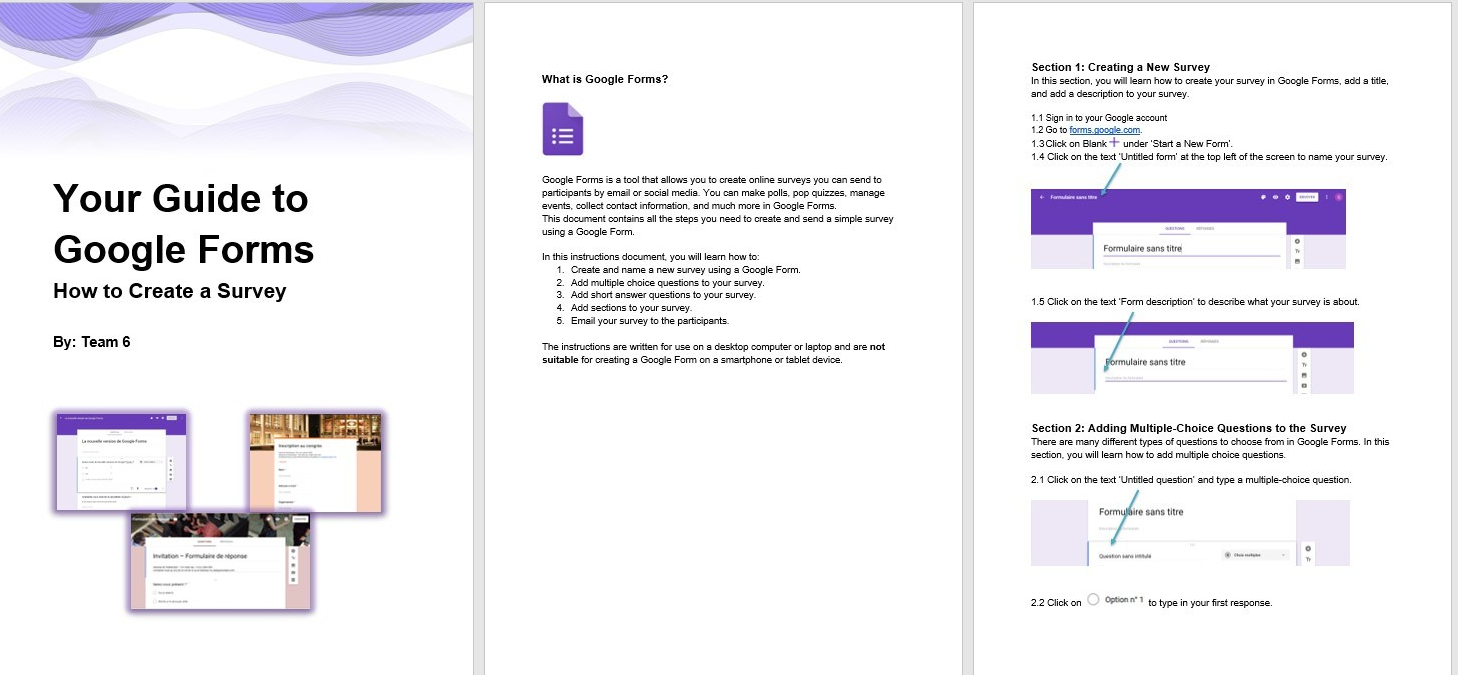
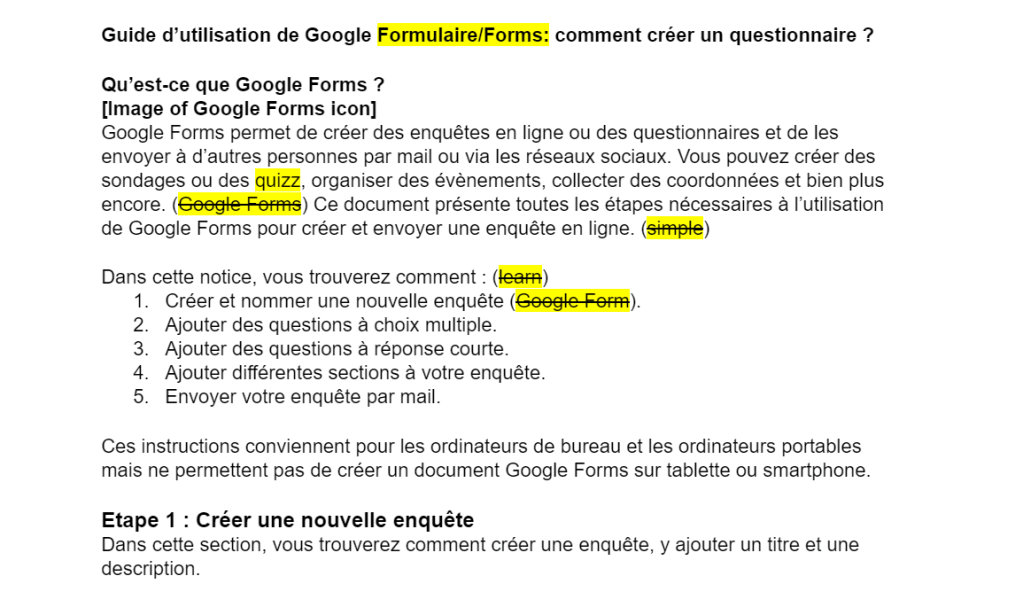
Now, since I was responsible for adding graphics and manipulating the layout, I used a lot of what I have previously learned in my time as a Technical Communication’s major here at UCF. I tried to keep font sizes and screen capture sizes as consistent as possible. I established patterns throughout each section, and I even created some exclusive vector images in Adobe Illustrator. I did learn that the process is extremely different when you are referecing the work of others. Because my team members were largely responsible for the content itself, I found myself struggling to reword, reprhase, or rewrite sections entirely. It’s certainly time to put as much faith in the process as I can bear. That being said, I was not quite sure how to anticipate preparing the document for translation. I added all screen captures in French, hoping that our Parisian translators will be okay with the images. Although, in true Uncertainty-Avoidant fashion, our French team members have stressed that they will upload their own screen shots to avoid the risk of any confusion in the document. Still, everyone seems to like what we’ve got so far. The end, I hope, is not far off!

Graphics Hurdles

Good evening, everybody!
Now that we have our first draft, we are moving forward to some important due dates that the group established; our Irish project manager, Aine Hogan, made a very reasonable schedule for everyone to follow. Each person still has an assigned role, though we have had some crossing over among individual roles. Michael and Tom have done some additional editing to our draft, as our writers Eveline and Siobhan continue to provide insightful suggestions. In addition, Guillaume from Paris has given me Google forms french screen shots to prepare the document for translation while I work on graphics this week. I will admit, having little experience in creating graphics for technical documents, I am nervous to undertake this role. I am well-versed in Adobe Photoshop and Illustrator, but it is certainly different when you are preparing images with technical communication and international audiences in mind. I am referring back to old textbooks like Redish’s Letting Go of the Words about online Help, our own Hofstede’s Software of the Mind, and Markel’s Technical Communication to remind me of key factors in page layout and image choice. I think as long as I maintain simple patterns and keep the reader focused on the instruction, our team members will consider the document ready for translation after I finish. Following Markel’s words in particular, I am aiming for a “less is more” approach; color choices should be conservative and reflective of colors found on google forms, and graphics should not draw the eye away from the wording itself.

Since the draft has been made earlier this week, there has been a lot of involvement on Slack, and I believe many of our team members (including myself) are struggling to read every message that comes about. Eveline has suggested earlier today that we should work on our roles in the document as independently as possible, then merge our ideas together once they are complete, rather than bounce every suggestion off in our Slack chat rooms. It is a very interesting dynamic, especially as many of our Irish team members are at different stages in their life (i.e. kids, full time career jobs) and we have had little communication with our Parisian counterparts. However, as the due date gets closer, the translators will step in and prepare our French document. I do hope we stay on this studious path, and that my partner Luke and I can still successfully balance our other classes on top of this international collaboration.